
Across industries, I’m seeing a shift toward a “seize‑the‑moment” operating logic: organizations are moving fast, optimizing for the immediate need, and adapting as they go.
Fractional leadership is rising. Teams form around specific outcomes and dissolve just as quickly. Playbooks are imported and deployed at scale. Speed, efficiency, and standardization are becoming the default – and for good reason.
But this also signals something deeper: a declining patience to stretch people and systems over time – the kind of sustained challenge that builds in‑house capability, shared context, and learning that compounds into real advantage.
So I wonder if we’re creating a new risk.
As organizations optimize for speed, they may also be eroding the very conditions that create differentiation: social capital, institutional memory, deep customer understanding.
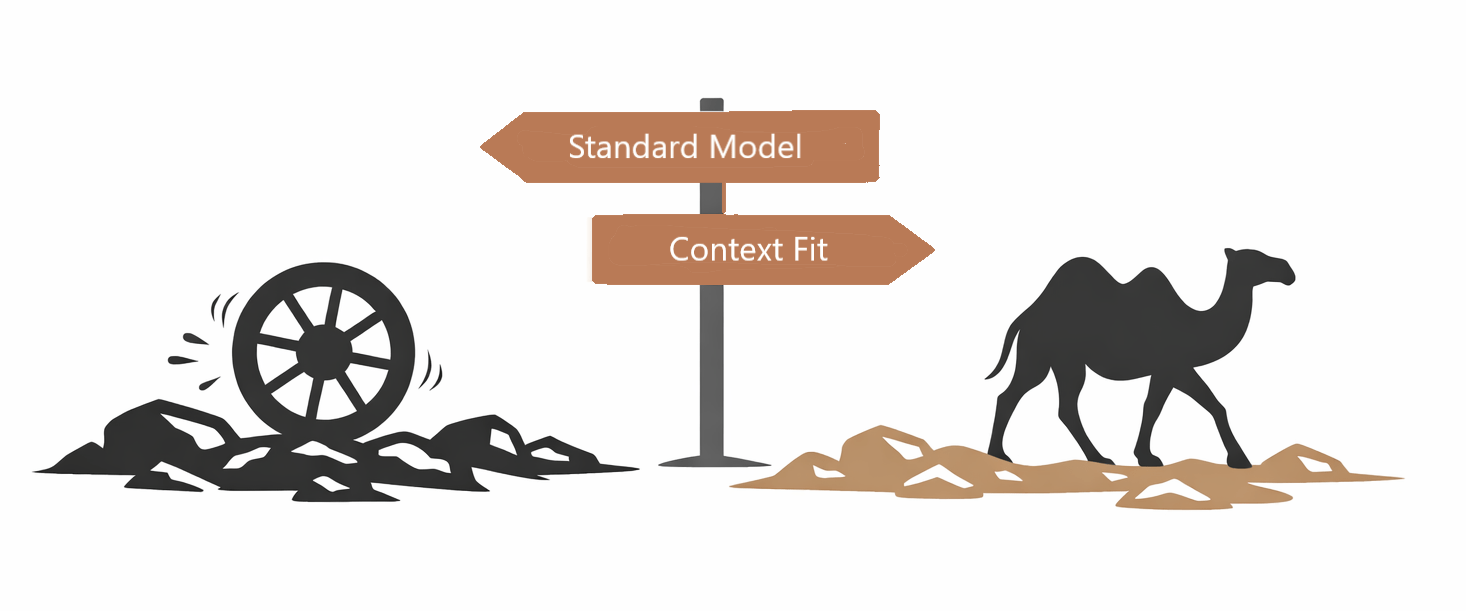
They become faster, leaner, yet risk losing strategic nuance. No longer reinventing the wheel, but adopting it even when the terrain calls for a camel.
AI is amplifying this. When everyone has access to similar tools, speed alone stops being a competitive advantage. So do ideas.
What becomes valuable is depth – of thinking, of insight, of culture, of judgment. The ability to know which problems are worth solving in the first place. The cultural stabilizers when everything around you is moving fast.
These things don’t emerge from acceleration alone. They require incubation, reflection, and learning long enough for insights to mature into something distinctive.
The real challenge isn’t choosing between speed and depth. It’s timing – knowing when to accelerate to capture opportunity and when to slow down long enough to build a lasting edge.
Because strategy isn’t just about outrunning everyone. It’s about out‑seeing them.

